Prepare folder sources
Choose two directory roots that represent the same logical artifact, such as previous and candidate release folders. Confirm orientation before enabling copy actions.
Apply built-in ignore presets or focused custom patterns so generated caches do not overwhelm meaningful changes.
Compare large trees
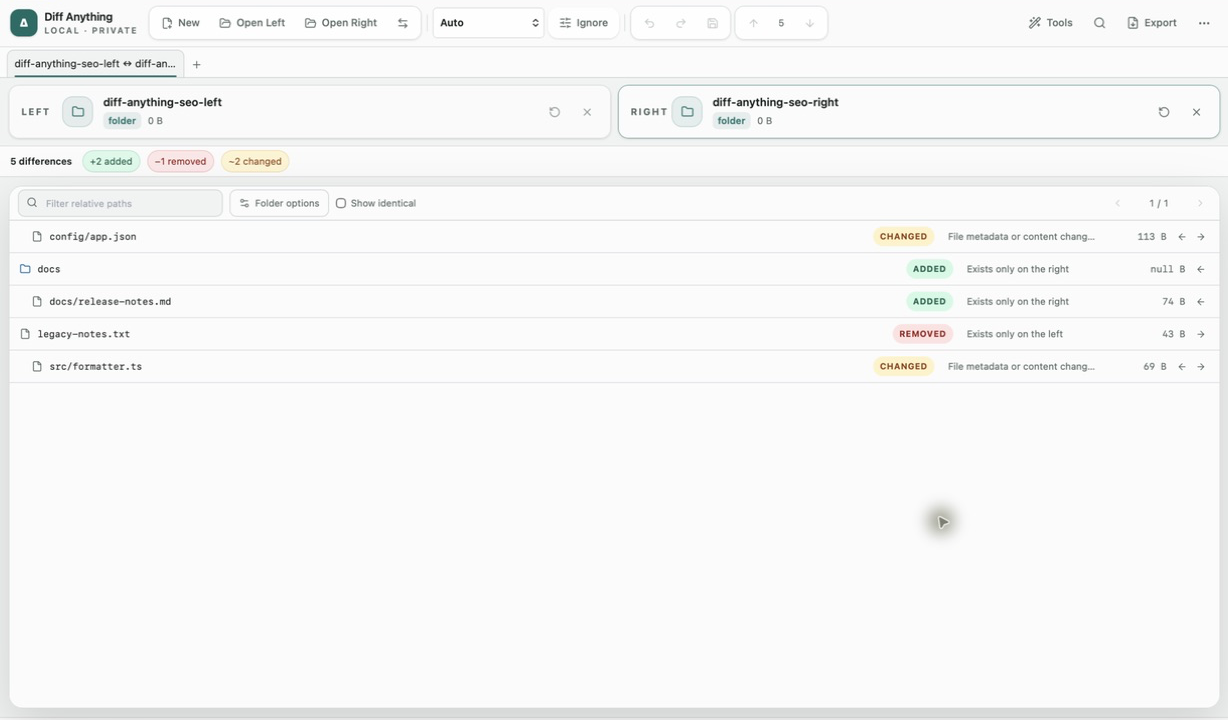
Folder comparison walks both sources recursively and progressively loads the result into two-pane tree or table layouts. Global search, status filters, and ignore patterns keep added, removed, changed, unchanged, and moved paths manageable.
Open a nested pair directly for content-level review. Structured files can use their semantic comparison, while moved-file detection distinguishes relocation from an unrelated delete and create.
On the free plan, the summary counts cover the whole tree and the list shows the first 100 entries; Pro lists every entry.
Synchronize with a plan and an undo path
A Pro synchronization starts from selected relative paths and can apply create, update, delete, and move actions left-to-right or right-to-left. Nested-selection pruning avoids duplicating work, and stale-result protection refuses a plan when the source state no longer matches the reviewed comparison.
Progress and cancellation keep long operations visible. Supported metadata is preserved, completed work is recorded in a durable recovery journal, failures use restart-safe rollback, and one-click undo remains available after success.
- Verify left and right orientation.
- Review every create, update, delete, and move action.
- Keep both roots available until the result is verified.
Compare spreadsheets and documents
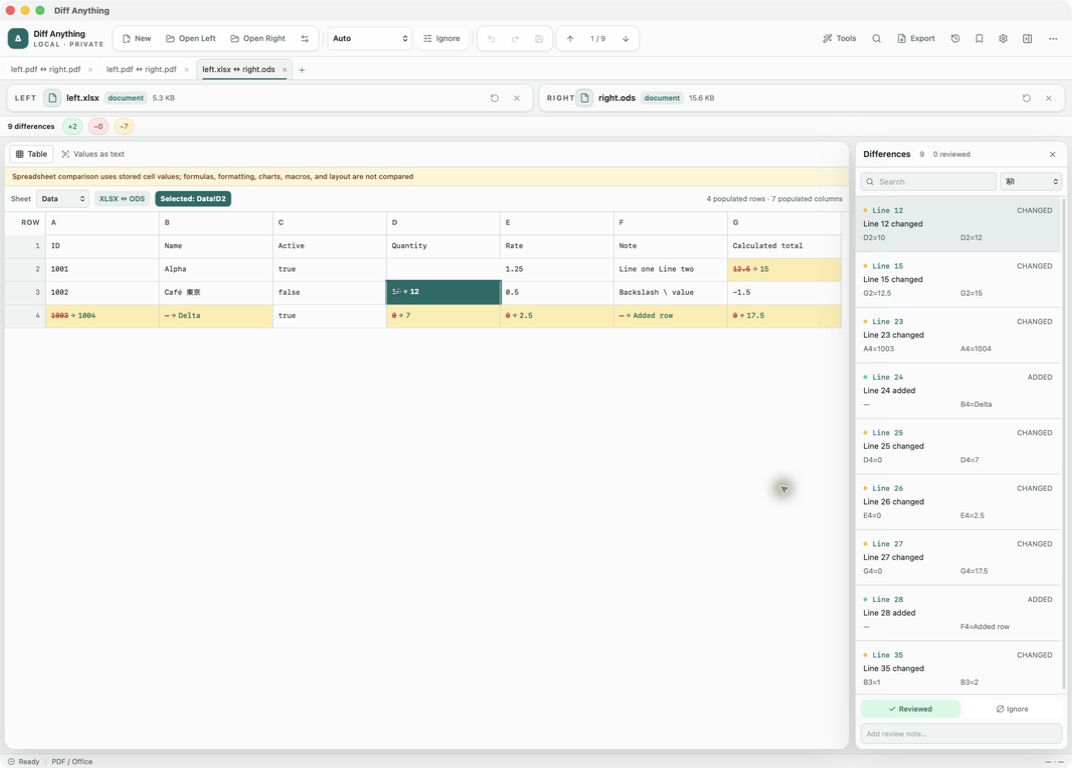
Spreadsheet comparison aligns stored values by sheet and coordinate across Excel, OpenDocument, and Apple Numbers workbooks, including mixed-format pairs, and can compare a CSV or TSV export with one sheet of a workbook. It does not compare formulas, formatting, charts, macros, or workbook layout. Word, PowerPoint, OpenDocument text and presentation, and RTF review remains extracted-text based: presentation differences are named by slide and other document differences are listed by line.
For PDFs, choose Visual diff to raster-compare each rendered page, highlight changed areas, and read its visual-match percentage. Choose Extracted text for wording; selecting a difference keeps that view active. Visual identity does not prove equal metadata, tagging, accessibility, or hidden content, and extracted text does not prove equal layout.
Use visual image tools
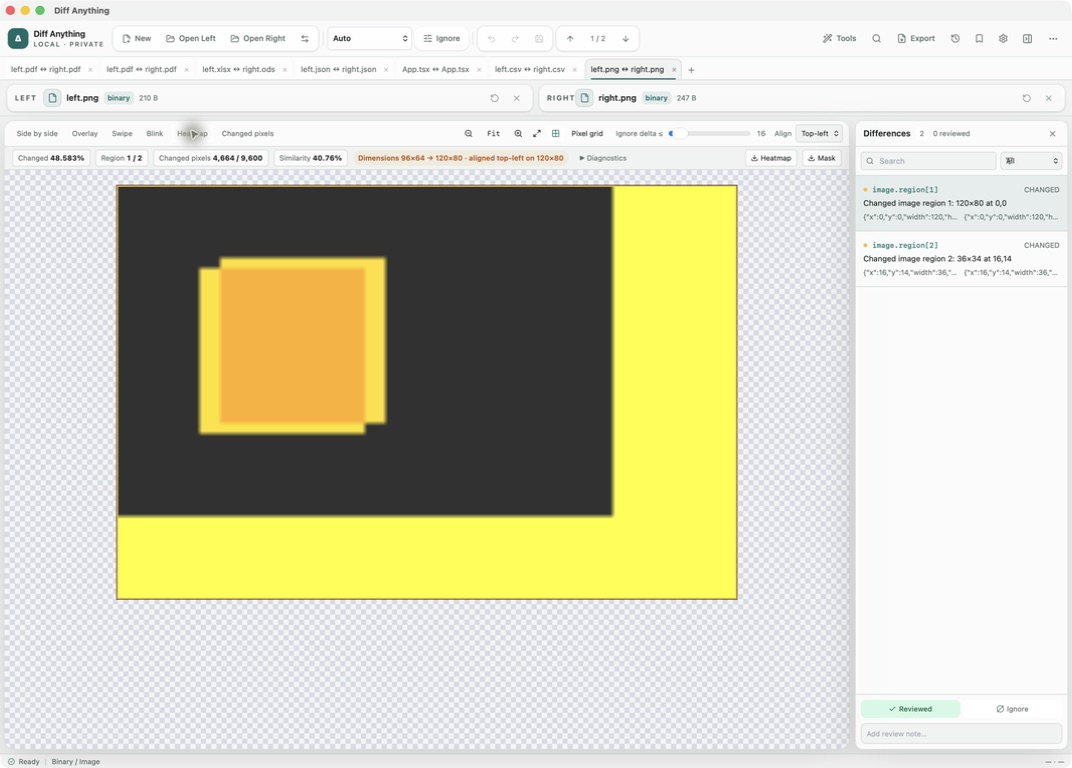
Image mode aligns both inputs on a shared transparent canvas and provides side-by-side, overlay, swipe, blink, heatmap, and changed-pixel views. Real-pixel zoom, a transparency grid, and a threshold make small raster and alpha changes easier to inspect.
The summary reports changed pixels, similarity, mean and root-mean-square error, maximum channel change, and the bounds of the changed area. Dimension changes stay part of the pixel analysis instead of disabling it.
Step-by-step guides
Free & Pro: what’s included
Available on the Mac App Store and Microsoft Store. Free desktop use lets you try every comparison engine for files up to 5 MiB per side and 10 new comparison sessions per local day; collection previews show the first 100 items and PDF previews show the first 3 pages. The free CLI supports text and JSON. A one-time Pro purchase removes the preview and session limits and unlocks larger sources within technical limits, saved profiles and history, report export, three-way merge, folder synchronization, batch manifests, trusted preprocessors, and every CLI mode.