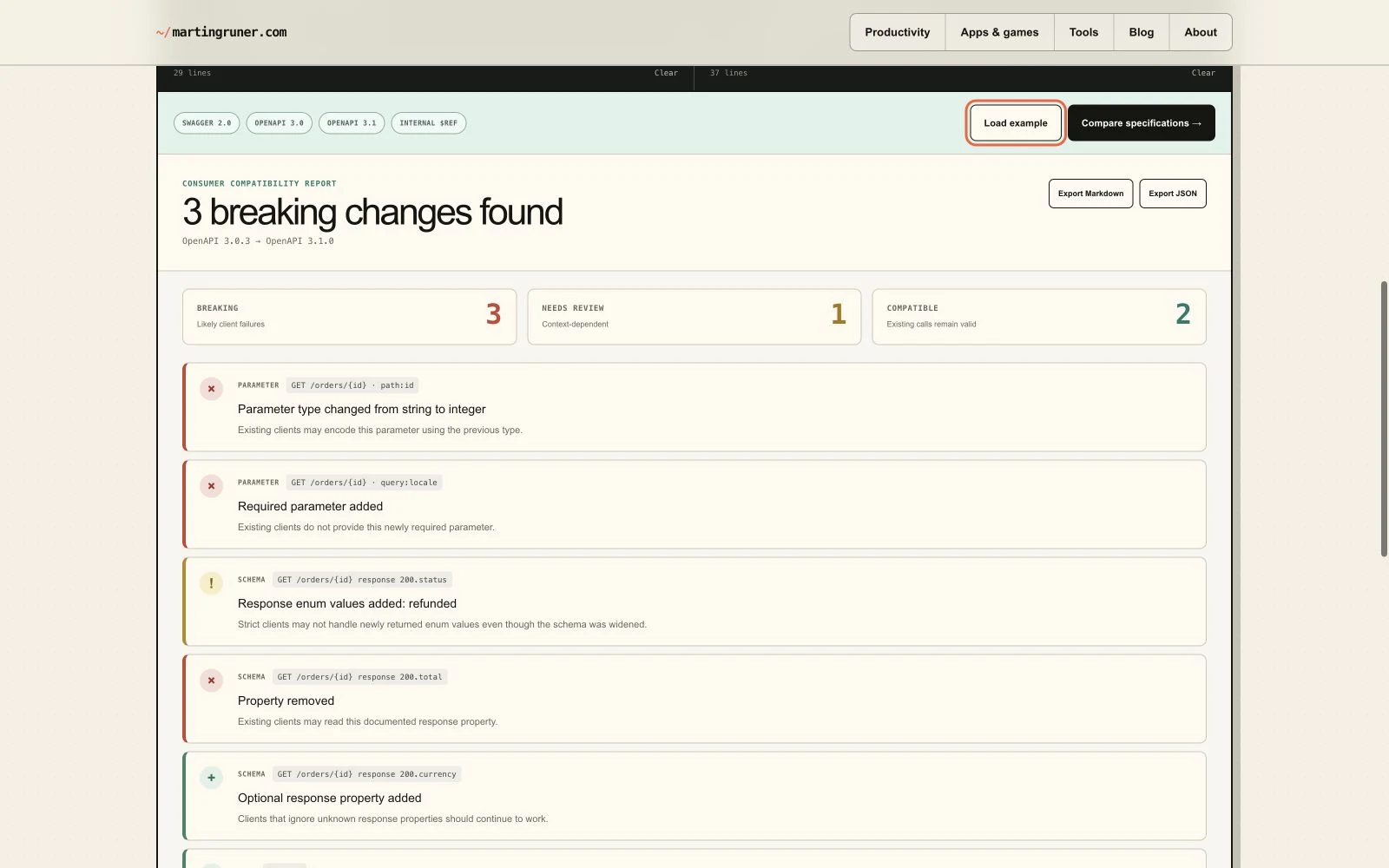
01 / Compatibility review
Put the existing contract on the baseline side
The baseline describes what current consumers already depend on. The candidate is the proposed replacement. Reversing them reverses the meaning of removal, addition, narrowing, and new requirements.
Keep both source versions available. A rule classification helps prioritize review; it does not decide whether a product-specific behavior is acceptable.
02 / Compatibility review
Review breaking and ambiguous changes separately
Removed paths, operations, parameters, properties, or enum values can break a consumer. Newly required input and narrower accepted types also deserve immediate attention. Additions are often compatible, while type, schema, security, and response changes can require context-dependent review.
Start with the reported breaking group, then inspect review-needed findings against actual clients and implementation behavior. A clean report cannot prove compatibility beyond the contracts and rules the checker examined.
- Breaking: a consumer capability or accepted value is removed or newly required.
- Review needed: the impact depends on use, semantics, or implementation.
- Compatible: the parsed contract change appears additive for existing consumers.
03 / Compatibility review
Know the browser checker’s limits
The free checker accepts Swagger 2.0 and OpenAPI 3.0/3.1 in JSON or YAML. It resolves internal references, but it does not fetch external references; it reports a warning when they remain outside the comparison.
Schema traversal uses a depth limit of eight. The output is a heuristic compatibility report, so important releases still need client tests and human review of runtime behavior, undocumented expectations, and semantic meaning.