Problem solved by DevDock Windows

Keep every development project ready to run

Organize local repositories, commands, health checks, and recent work in one Windows development workspace, with database tools in Pro.

See it in the app

A focused workflow, on your computer.

Local project data, operating-system secret storage, read-only local audits, and no source upload.

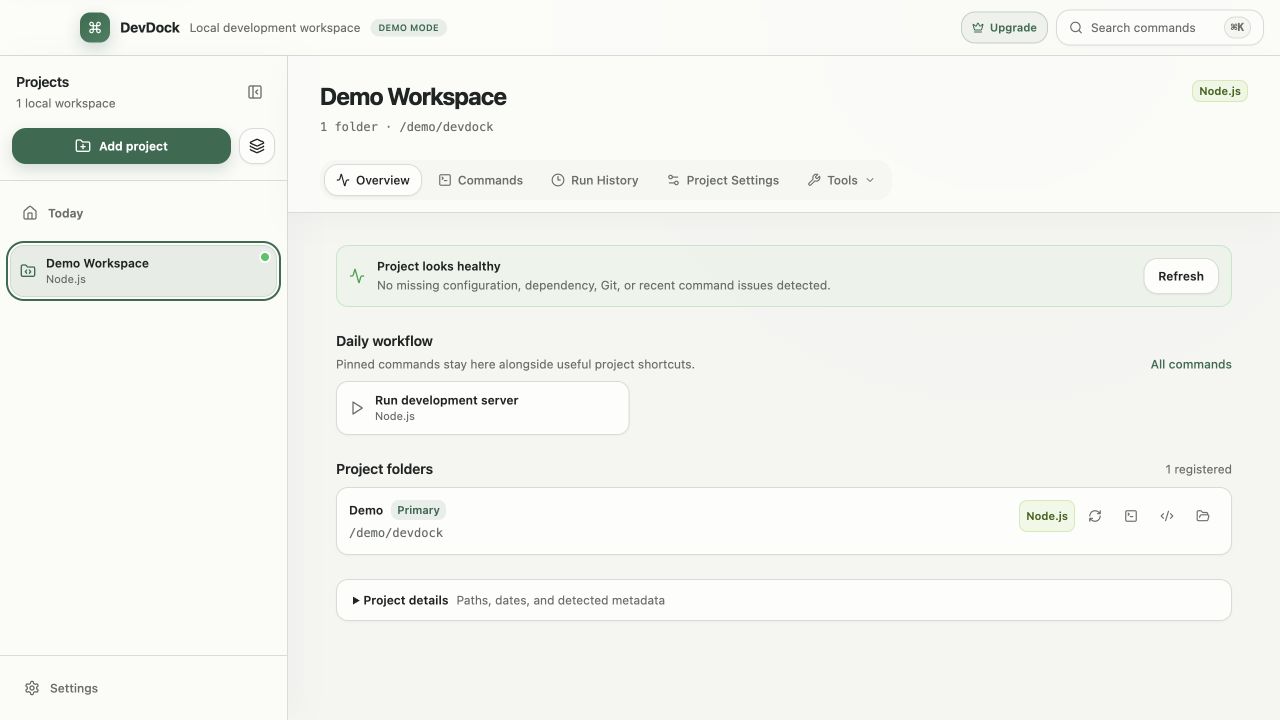
DevDock project overview showing project health, daily workflow, and registered folders
DevDockA DevDock project keeps its folders, daily workflow, health, and recent activity together.

The problem

Why the usual workflow gets in the way.

A project is more than a folder. Its useful commands, runtime targets, database context, and last known state usually end up scattered across terminals, notes, and bookmarks.

The solution

How DevDock handles it.

DevDock gives each local project a persistent workspace. Register a repository—or, with Pro, a monorepo's subprojects or several related folders—and return to the same commands, health information, shortcuts, and run history later.

01 / Project re-entry

Define the real project boundary

Start with the unit of work you think about and ship together. That may be one repository, a monorepo, or several separately located folders; projects with more than one folder require Pro. Give related folders role-based labels so similar commands remain distinguishable.

Do not move or flatten repositories just to create an overview. The useful boundary is the one that preserves each folder's real working directory while keeping the product workflow understandable.

  • Use one project for folders that contribute to the same product workflow.
  • Split independently owned or released codebases.
  • Name folder roles such as Backend, Web, Mobile, or Infrastructure.

02 / Project re-entry

Capture the path back to useful work

Record the recurring servers, workers, watchers, tests, and setup tasks with their exact working directories and execution targets. Put dependent steps into an intentional order instead of relying on terminal history.

A return path is useful only when it remains reviewable. Keep executable, arguments, working directory, and host-or-container target visible before a command starts.

  • Prefer bounded commands for the first readiness check.
  • Keep folder-specific tasks attached to their folder.
  • Review consequential commands before execution.

03 / Project re-entry

Separate detected context from current health

Recognizing a framework or manifest does not prove that its SDK, executable, Docker engine, or dependent service is currently available. Review configuration, toolchain, Git, Docker, and recent-run evidence separately.

When a command fails, preserve the exact task, directory, target, exit state, and output. Run history keeps that record, so you can review the failure beside earlier runs instead of reconstructing it from memory.
Clear answers

Common questions about manage development projects on Windows.

Does DevDock move or copy project folders?

No. DevDock keeps references and workflow context around existing local folders; the repositories remain in their original filesystem locations.

Can one DevDock project contain several repositories?

Yes. A project can represent one repository, a monorepo, or several separately located folders. Multi-folder projects are a Pro feature.

Does project detection upload source code?

No. Detection works against registered local folders and does not require source upload.

Three short steps

Turn a folder into a repeatable return path.

  1. 01

    Register the local project folder.

  2. 02

    Review detected tools, folders, and health.

  3. 03

    Pin the commands you use to return to work.

Available for Windows

Solve it with DevDock.